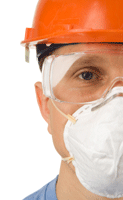
Choosing the right respirator relevant to the nature of the employment is critical to a worker’s safety.
Exposure to different hazards means that not just any respirator will suffice.
Air-Purifying Respirators (APR)
Air-Purifying Respirators (APR) are designed to filter airborne contaminants such as fumes or noxious dust.
Some APR models use a canister or cartridge that contains material to absorb or chemically neutralize contaminants.
APR designs
- Full face piece - Fully covers the face from underneath the chin to an area above the eyes and provides added eye protection from chemical irritants.
- Half-face mask - Covers from beneath the chin up to and including the nostrils and provides respiratory protection for the nose and mouth.
- Quarter-mask - Protects the mouth and nose only and is lighter and less obtrusive.
- Mouth bit respirator - Normally used for escaping a hazardous situation; it includes a bit inserted into the mouth and a nose clip to seal the nostrils.
Supplied-air respirator (SAR)
Supplied-air respirators (SAR) provide breathable air via an airline or a compressed air tank.
One SAR type uses a loose-fitting hood or helmet supplied with purified air through an airline and may have facepieces that fit loosely.
The other SAR type uses a snug-fitting half or full facepiece with a tight respiratory inlet for higher protection.
Choosing the Most Suitable Respirator
Selecting the most suitable respirator should be performed by a qualified safety professional after they have identified and evaluated the respiratory hazard.
The expert will consider contaminant type, oxygen levels, physical demands, and the limitations of available respirators.
Employers should have a Respiratory Protection Safety Plan that documents selection, fit testing, maintenance, and employee training.
For broader guidance on hazardous materials in the workplace, see Hazardous Materials and Workplace Safety.
For specific information about chemical exposures and controls, see Understanding Workplace Chemical Hazards.
Key Questions to Ask
- Have you established the existence of a hazard by reviewing material warnings, chemical components, or potential particulates released by the work?
- Is there limited oxygen present in the work area?
- Is the hazard airborne (particulate, fume, or vapor)?
- Will the respirator be needed for emergency use or firefighting?
- Is the work strenuous or performed in hazardous atmospheric conditions?
- Is there any agent present that is potentially fatal, carcinogenic, absorbable through the skin, or acts as an irritant?
- Will the work be in confined space or expose workers to abnormal temperatures?
The key is that respirators should be matched to the specific work and hazard.
Choosing the proper respirator is vital to protecting workers across many types of employment, and when in doubt, talk to an agent.
Frequently Asked Questions
How do I know which respirator to use?
A safety professional should assess the hazard, oxygen level, and work conditions to select a respirator that fits the contaminant and the user.
Can I use a half-face respirator for chemical fumes?
Half-face respirators protect the nose and mouth but do not protect the eyes; they may be appropriate for some fumes if the cartridge is rated for the chemical and eye protection is provided separately.
How often should cartridges or filters be replaced?
Replace cartridges and filters according to the manufacturer's guidance and when you detect odor, taste, increased breathing resistance, or reach the service-life limit.
Do powered air-purifying respirators (PAPR) offer better protection?
PAPRs can reduce breathing resistance and provide higher assigned protection factors for some hazards, but selection depends on the contaminant and work tasks.