Overview
An incident at a day care illustrates how routine cleaning can become an insurance issue. An employee applied ammonia to a toilet seat and several children developed rashes afterwards.
The insurer issued a reservation of rights citing an environmental exclusion in the general liability policy while the claim was investigated.
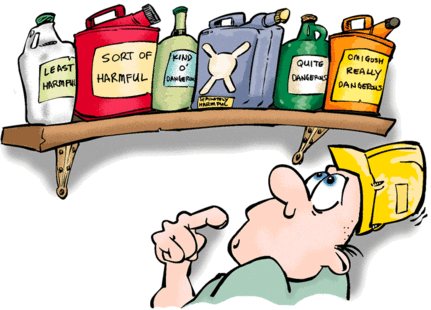 The facts raise two separate issues: whether the event falls under a policy exclusion that bars environmental or pollution-related claims, and how to manage chemical risks in a workplace that serves vulnerable populations.
Insurers often treat chemical releases conservatively because long-term cleanup and bodily injury claims can be costly. Understanding policy language and practical risk controls can reduce exposure and clarify when coverage applies.
Key takeaways
- Insurers may reserve rights if they suspect an exclusion applies, even while they investigate a claim.
- Mixing common cleaning chemicals can create sudden, toxic reactions that may trigger pollution exclusions depending on policy wording.
- Training, storage controls, and targeted liability products can reduce both incidents and coverage gaps.
How it works
A reservation of rights letter tells the insured the carrier will investigate and possibly defend, but reserves the right to deny coverage later if an exclusion applies.
It does not mean coverage is automatically denied; it preserves the insurer’s options.
Many general liability policies include an environmental or pollution exclusion that bars coverage for certain discharges, releases, or exposures. These exclusions vary in wording and often hinge on terms like “sudden and accidental,” “gradual,” or whether the release was expected or intentionally caused.
In the ammonia-plus-bleach scenario, the chemical reaction is sudden and harmful even though each person intentionally applied a cleaner. Depending on the exclusion language and the policy’s definitions, an insurer could argue the event is excluded as an environmental release.
What it may cover (and what it may not)
General liability often covers third-party bodily injury caused by business operations, but environmental exclusions can carve out coverage for chemical releases, contamination, and cleanup costs.
Coverage is more likely when an injury is clearly traceable to an accident that the policy’s wording intends to cover and not to an excluded pollution event. Conversely, if the policy defines the incident as a “release” or ties exclusions to hazardous substances, the carrier may successfully deny or limit payment.
Businesses that need broader protection should evaluate separate environmental or pollution liability products designed for specific risks; consider standalone options such as General Merchandise Site-Specific Pollution Liability or a more comprehensive policy like Pollution and Environmental Liability for Businesses.
For subsurface or fuel-related exposures, consider policies tailored to those hazards such as Seepage and Pollution/Energy Insurance.
Common mistakes to avoid
Do not assume common household cleaners are risk-free in a commercial setting. Incompatible chemicals stored together or used without training increase the chance of harmful reactions.
Avoid vague labeling, unlocked storage, and allowing untrained staff to handle concentrated chemicals. Those operational lapses magnify both injury risk and the chance an insurer will find the incident excluded.
Questions to ask an agent
Does our general liability policy contain pollution or environmental exclusions that could apply to cleaning chemicals?
Would a separate pollution or site-specific policy fill gaps for bodily injury or cleanup costs related to chemical reactions?
What loss-control or training resources do you recommend to reduce chemical exposure incidents?
Next steps
Review your policy language with your broker or risk manager and get clarity on any pollution exclusions that might apply to routine cleaning incidents. Consider targeted environmental liability options and update operating procedures.
Implement training on chemical use, restrict certain products to trained staff, and separate incompatible chemicals in storage. Regularly check Material Safety Data Sheets and label containers clearly.
If your operations involve vehicles, fueling, or maintenance work, consider coverage options like Pollution (Auto Facility) that address those exposures.
If you want to explore coverage options or get a quote, talk to an agent about site-specific pollution solutions and loss-control programs.