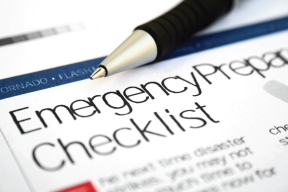
 The confusion highlights the need for personal contingency plans in the event of a terrorist attack, accident, or natural disaster. This is especially important for people living or working in major cities. Large numbers of people crowded into small areas and limited escape routes can easily create panic and confusion during a mass evacuation or other emergency.
Government security agencies and private businesses have developed plans for evacuating public buildings, hotels, and office buildings in the event of an emergency. Many buildings in New York City, for example, have assembled emergency kits — including a blanket, flashlight, whistle, non-perishable foodstuffs, water and, in some cases, smoke hoods — that they make available to occupants in the event of an evacuation. In most cases, however, the responsibility of building operators and security agencies ends once the buildings are evacuated. There’s little thought to what happens to the occupants once the buildings are empty.
At the very least, people who have developed a plan will be less panicked and confused than those who have left their fate to chance. Perhaps the best reason for having a personal plan, however, is to reduce your own danger. Jihadists who probably followed the May 10 event in Washington, D.C., could have gained information from this false alarm on points of vulnerability, and might use this knowledge in future attacks in the D.C. area. For instance, a plane could be sent as a decoy to trigger a mass evacuation. Then, when a large mass of people gathered in the streets, a bomb could be detonated, causing heavy casualties.
Personal protection specialists and others responsible for the security of executives and VIPs should develop contingency plans for the home office, and for occasions on which the executive is traveling. When designing such a plan, it’s best to assume that communications will be interrupted or unavailable. The plan should also consider potential outages of public transportation and electricity. If ground transportation is available, pre-arrange for a nearby safe haven outside the city, equipped for a lengthy stay. Suggest that other employees can make personal plans tailored to their particular situation.
It’s important to recognize that even a good contingency plan can be worthless if protective measures by authorities during an emergency impede its execution. For example, bridges and tunnels might be closed, and streets blocked or jammed with traffic, meaning that one might not be able to travel to safety or to pick up family members or coworkers. People whose plan calls for a flight out of the city might be unable to get to an airport or helipad and, once there, find that air traffic has been grounded, as happened after the Sept. 11 attacks. For these reasons, it’s best to have several alternate plans that provide for multiple scenarios and include various evacuation routes. Once the emergency is announced, it’s probably too late to start devising a plan.
When an employee is traveling, the plan also should be coordinated with the home office, so that executives will have a basic idea about the location of the person and of what’s being done in the affected city. Even if movement and communication are impossible, having a plan that has been coordinated with the home office will be better than reacting to events as they happen.
Coordinating these plans with co-workers and family members will also help to ease stress, especially when the plan includes pre-arranged meeting points if the office or home is affected by the emergency. The Department of Homeland Security maintains a Web site (www.ready.gov) that can help private citizens and businesses develop such a plan.
If a real emergency arises, situational awareness should be the first step in dealing with the threat or in making an escape. People who want to make the best of an emergency will assess the situation quickly, determine which contingency plan will work best — and then act!