
Overview
This article summarizes a short Webinar review of 15 HR forms and tools that influence a company's bottom line.
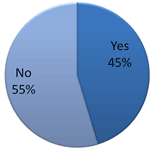
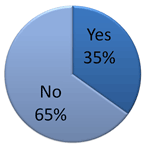
The Webinar also included three quick polling questions about common HR practices: social media policies, written hiring processes, and whether employee handbooks guide employees on how to succeed.
The original presentation emphasized practical, consensus-built policies—created with HR, marketing, IT, and employee input—to reduce risk and improve performance.
If your organization lacks formal HR processes, this overview explains where to start and which common gaps to close.
For readers focused on leadership and HR planning, consider reviewing resources on Attracting Leadership Talent and HR Opportunities to align hiring practices with long-term goals.
Key takeaways
- Create a social media policy jointly with HR, marketing, IT, and employees to reduce risk and gain buy-in.
- Formalize a written hiring process to consistently attract and select the right people for growth.
- Use the employee handbook not just to protect the company, but to teach how to be a good employee.
How it works
Start by auditing current practices: do you have written policies, a documented hiring workflow, and a handbook that communicates expectations?
An audit highlights gaps and points for improvement.
Next, assemble a small cross-functional team to draft each document.
Include representatives from leadership, HR, marketing, IT, and rank-and-file employees to ensure practicality and acceptance.
Finally, pilot the materials, solicit feedback, and revise before broad rollout.
Training and reinforcement help policies move from paper to everyday behavior.
If your organization handles sensitive documents, review ShredderGuard - Document Destruction Insurance for related risk considerations.
What it may cover (and what it may not)
- What it should cover: acceptable social media behavior, confidentiality boundaries, conflict reporting, and examples of good workplace conduct.
- What a hiring process should cover: job profiles, standardized interviews, reference checks, and decision criteria to reduce bias.
- What a handbook should not be: a legal-only document that fails to explain how employees contribute to success.
- What it may not cover: jurisdiction-specific legal advice or complex regulatory compliance topics that require counsel.
Common mistakes to avoid
Don't let lawyers write the entire handbook without business input; over-legalized language often obscures expectations and discourages adoption.
Avoid ad-hoc hiring decisions without defined criteria; this leads to inconsistent outcomes and higher turnover costs.
Never implement a social media policy as a top-down edict.
Policies created without employee input are often ignored or resented.
Questions to ask an agent
Does our current insurance program cover employment-related claims such as wrongful termination, discrimination, or harassment?
What documentation or HR practices do carriers typically want to see to reduce employment-practice liability exposure?
Can a risk assessment or loss-control review help prioritize which HR policies to develop or strengthen first?
Next steps
Begin with a simple gap analysis: list which of the three items—social media policy, written hiring process, and handbook guidance—are missing or incomplete.
Use a cross-functional working group to draft concise, practical documents and pilot them in a single department before companywide adoption.
For practical webinar and marketing-related insights that complement HR planning, review HR Webinar Insights and Marketing Strategies.
If you serve nonprofits, see Insurance for Humane Societies for related coverage considerations.
If you want professional help to align HR practices with risk management and coverage, consider discussing your situation with an expert—use the option to talk to an agent for tailored guidance.
Frequently Asked Questions
Do small companies need a social media policy?
Yes. Even small organizations benefit from clear guidance to protect reputation and set expectations for employee online conduct.
How formal should a hiring process be for a growing business?
Start with standardized job descriptions and interview questions; increase formality as hiring volume and role complexity grow.
Can an employee handbook be both protective and instructive?
Yes. A well-designed handbook balances legal protections with practical guidance on workplace behavior and performance expectations.