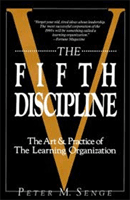
According to Wikipedia, "a learning organization is the term given to a company that facilitates the learning of its members and continuously transforms itself." This concept was popularized by Peter Senge in his book The Fifth Discipline. Senge ran a think tank at MIT Sloan School of Management, and his Fifth Discipline Fieldbook provides a practical guide companies can use to build a learning organization. For industry-specific contexts, see Learning Organizations and Healthcare Insights.
According to Senge, there are five main aspects to a learning organization. Let's discuss how each of those might apply to the HR equation.
Five main aspects
- Systems Thinking. This means that HR doesn't operate in a bubble, but rather in concert with other aspects of the system. Understand how HR affects everything in your business from operations to sales, marketing, customer support, and so on. A strategic HR manager will take a cross-disciplinary approach when it comes to their HR practices and training.
- Personal Mastery. This means you commit yourself to the process of learning. How many books have you read in your area of expertise during the last year? Do you receive trade publications, attend trade conferences, network with your peers, and look for additional learning outside of your expertise? Do you make sure everyone else at your company is engaging in personal mastery?
- Mental Models. Basically, this means the assumptions or framework in which each of us operates. To become a learning organization we have to challenge these models, and HR must be part of this conversation. A classic mental model in the HR arena is the management of performance evaluations. In most organizations, this model is more than 50 years old, meaning that it's time to retire it. What new model can you develop that will generate integrity, trust, and better performance?
- Shared Vision. All business authors stress the importance of this factor. Jim Collins emphasized it in his Good to Great book, as did Senge in The Fifth Discipline. How is HR helping to push out and market your organization's vision? How are you making it "visual"? For example, if I walked into your company would I know what your vision is without having to ask about it? If not, start working with the marketing department and engage in some internal "branding" of the vision.
- Team Learning. As the saying goes, none of us is as smart as all of us. How can we create vigorous dialogues in which we all learn from each other? I encourage you to go to the five-minute video I did on a very powerful team learning process that anyone can facilitate.
In growing your business as a "learning organization," you'll probably need to deal with obstructions. Opposition might come from individuals trying to protect their turf, one department not wanting to communicate with another, or a lack of empowerment among leaders or employees.
An organization that's very large may struggle to share information fully (Senge suggests a cutoff point of 150 employees). Cultural dimensions can also impede the learning process. For practical approaches to organizational barriers, see Learning Organizations and Business Challenges.
Healthcare organizations face specific compliance and liability concerns; see Health Care Clinic and Nonprofit Liability Insurance.
What barriers have you identified to building a knowledge organization? What strategies do you have to get past these blockages? If you have yet to do so, consider reading Senge's The Fifth Discipline as well as The Fifth Discipline Fieldbook to find concrete practices and case examples.
Frequently Asked Questions
What is a learning organization?
A learning organization is one that supports continuous learning for its members and adapts its practices based on that learning to improve performance over time.
How can HR promote personal mastery?
HR can promote personal mastery by supporting training budgets, encouraging conference attendance, providing access to learning resources, and creating individual development plans.
What are common barriers to becoming a learning organization?
Common barriers include siloed departments, resistance to change, lack of leadership support, limited information sharing, and insufficient incentives for learning.
How does team learning differ from individual learning?
Team learning focuses on collective problem-solving and shared dialogue, which helps groups integrate diverse perspectives and produce better outcomes than isolated individual efforts.