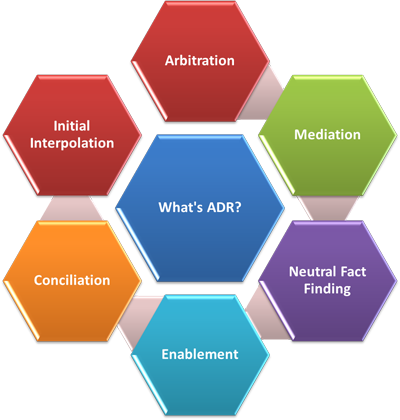
The use of alternative dispute resolution (ADR) by the insurance industry might not be new, but a growing number of insurers are turning to techniques such as third-party arbitration and mediation to help resolve pending claims and to prevent coverage litigation. For many claims, especially class actions, insurers and policyholders may be better served by enlisting help in settling claims outside of a courtroom.
"There's a myth that the insurance industry has a wondrous capacity for reserves and that it doesn't pay claims in order to hold onto and use policyholders' funds," says Harry Mazadoorian, distinguished professor of dispute resolution law from practice at Quinnipiac College School of Law in Hamden, CN. "That's simply not true. The transactional costs of litigation far exceed the savings that can be generated by holding onto the money."
Mazadoorian, a former assistant general counsel for CIGNA, says the use of ADR dates back more than 200 years, according to a 1793 policy issued by the Insurance Company of North America that contained ADR provisions. What is new today, he explains, is that as a growing number of policy disputes get added to overcrowded court dockets, the insurance industry is increasingly turning to ADR to settle pending claims.
"More than 90% of lawsuits are settled before adjudication," Mazadoorian says. "The transaction costs and delays companies face in connection with litigation argue in favor of finding an earlier resolution to disputed claims."
For every dollar spent on intercompany arbitration, the return on investment is $18.92, according to D. Kay Smith, chief executive officer of Tampa, FL, based Arbitration Forums, Inc., citing a survey recently conducted by the nonprofit provider of dispute resolution services.
Mazadoorian says ADR is best suited for claims in which the parties are not disputing any liability issues, just the amount of the claim settlement. He adds that courts are increasingly recommending its use in personal injury claims.
Although some policies issued today contain ADR provisions, the majority still do not.
"Property insurance policies, while providing appraisal clauses for quantum disagreements, typically do not provide remedies for liability disputes short of litigation," says Gail Bonitati, director, forensic and litigation services, KPMG LLP, in Providence, RI. "The general belief was that the insurance company stood a better chance in court with all of the evidentiary processes, precedents, smart judges, and the appeals process available."
However, she adds, that belief often did not prove true when cases were actually litigated. Unless fraud is involved, "an insurance company is much better served by trying to resolve liability disputes via some sort of alternate dispute mechanism as opposed to litigation," says Bonitati. "The long-held notions seemed to hurt rather than help. The prevailing wisdom of seeking a bench trial did not bring the 'learned' decision that one had hoped for, litigation stretched out over years and years, and that at the end of the day, there were no winners."
Mazadoorian says a number of ADR protocols have been developed by the CPR Institute for Dispute Resolution. Under the CPR Insurance Industry Dispute Resolution Commitment, about 36 insurers and reinsurers have agreed that they will attempt to resolve Commercial Lines coverage disputes with other insurers through confidential negotiation or nonbinding mediation.
When there's a large number of claimants involved, and potentially billions of dollars at stake, class-action settlements can be reached more readily with ADR and independent review, says Philip Daddona, principal, KPMG's forensics and litigation practice. "A pending dispute can take up plenty of time for executives."
"Insurers can be the biggest targets for suits claiming deceptive or discriminatory sales practices. They don't do this intentionally, but all insurers can be subject to this," according to Daddona. "Marketing and sales decisions made by insurance companies may seem like a good idea at the time, but there can be unforeseen consequences. And with e-commerce, they'd better be sure their message is right."
The insertion of alternative dispute resolution services into a class-action lawsuit can provide "an added comfort level and trust factor in settlement to all parties," Daddona notes. "All parties get administered fairly as an independent party looks at the issues, and it's an extra negotiating chip that can be useful in settling cases."
ADR also inserts an independent perspective into a dispute. This independent evaluation is a way to "double-check and make sure the judgment makes sense," so the insurer "can go back to the policyholders and say there was an objective settlement," adds Henrietta Chang, a KPMG consultant.