 Leadership means a willingness to embrace change in order to navigate the daily journey of business with the most powerful tools possible. Jack Burke warns that If you can't get them to where they want to go as quickly and as comfortably as possible, they'll be looking for another ship on which to make their journey.
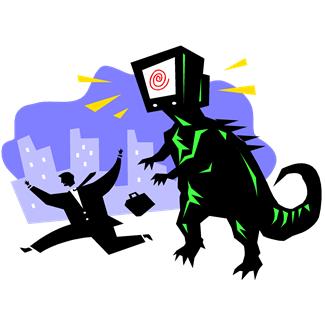
When my philosopher friend Mike Manes of Square One Consulting talks about change, he reminds people about those big bad dinosaurs that couldn't survive climatic change and died. Recently, I received a letter from a partner in an insurance agency, who wrote:
“I have one business partner who thinks that to be successful in the future, you must merge with other agencies, open up non-standard offices, and hire new producers. I have to agree with him about all of those options. We did merge with another agency over two years ago and with another agency just over a year ago. We've also looked at opening up another office and hiring a new producer.
“However, my biggest concern right now is being prepared internally for the future, and keeping up with the latest technology. My partner is in his 50s and doesn't want to change the way he does business. He still requires the CSR to pull the file and come into his office to discuss the file or for him to ask a question. He has very little computer knowledge and doesn't want to go to t-filing in CL or to start using a scanner.”
This problem isn't a new one; in fact it's legion. And it's not limited to the insurance business — it's rampant in nearly every industry. In fact I have frequent conversations with many experts and consultants about this specific topic: The inability of a business owner to change.
Does this mean that the owner must jump into the electronic pool with both feet, attend classes to learn computer technology, and begin subscribing to hi-tech newsletters? Not a bad idea. Hearken back to an earlier day as you ask yourself how well a business owner might've survived if they'd refused to integrate that new technological contraption of a telephone into their business. Or how productive might that business have been if the secretary had to write letters in longhand because the owner didn't trust typewriters?
Unfortunately, many of us baby-boomers cling to our first impressions of the initial computer technology, where it seemed that computers (think data processors) merely doubled the workload. After all, it meant doing everything twice — once for the computer and then again for the old methods because we didn't trust the computer. Those days have thankfully changed and only a true “dinosaur” doesn't appreciate the productivity benefits of computer usage.
THE JOB DESCRIPTION
Before we castigate the recalcitrant business owner described in my opening correspondence, let's look at the job description of an owner. I believe that it can be summed up fairly easily:
- Create the great vision on which the future of a company will be built.
- Provide a nurturing, motivational and empowering environment for staff.
- Develop the philosophical framework to serve the clientele.
- Generate a fair return on investment for the company.
Although this might seem a bit over-simplified, these four steps cover just about everything that a true leader must do without getting into the daily minutia. To use a metaphorical example, the CEO of a national bakery can run the company without ever having baked a loaf of bread — as long as they understand the process and are keenly aware and sensitive to both their employees and their customers. The conundrum, in the case of our friend's partner, is that technology is an essential component for every facet of this job description.
STEP ONE: THE VISION
The future is being built block by technological block. Forget the retail side of Internet commerce; think in terms of communication, information resources, and back-end supply chain. Some pundits say that Jack Welch of General Electric blew his chance to retire with a bang when the deal to merge with Honeywell fell through. I disagree. Welch had already given GE the most valuable farewell gift possible: An introduction to the Internet.
Although he was initially blind to the possibilities of the Internet, gentle spousal coaxing opened his eyes to a remarkable vista of electronic opportunity —not necessarily in selling stuff on the Internet, but in using it to more effectively manage the business of GE's far-flung empire. By coordinating all travel electronically, the company is already saving more than $1 million per week (and that's only one small area).
Even if a true leader never touches a computer keyboard they must understand and appreciate the value of technology both today and in the future. How can one envision a future while ignoring the tools with which it will be built?
STEP TWO: THE EMPLOYEES
A friend of mine manages one of LA's top Hispanic radio stations. When the corporate ownership made the switch from English-speaking rock to Hispanic, he was soon the only person there who didn't speak Spanish. Within a month he had a tutor arriving at his office daily and culminated his training with two weeks of immersion learning in Mexico City. He knew that he couldn't manage a staff who spoke a language he didn't understand.
We baby boomers grew up in an analog world. The young people we're hiring have grown up in a digital world. We not only speak different languages, our brains are hard-wired differently. A true leader must acknowledge this fact and adapt to it by adapting their own wiring to understand their employees. To help reach this goal, there's a wonderful prayer that I rely on:
God grant me the serenity to accept the things I cannot change, the courage to change the things I can, and the wisdom to know the difference.
Even if you can't perform the most basic task on a computer, you need to establish a high-tech environment that will empower your employees to maximize their productivity and usefulness to the company. Encourage their experimentation and support their accomplishments.
STEP THREE: THE CLIENTS
Here's the rub! Business is not about you, the owner. Business today is all about the customer . A business that isn't sensitive to the needs, wants, and desires of its clientele will soon be out of business. You, as the business owner, no longer set the expectations of your clients. They already have these expectations and it's up to you to meet and exceed them.
Today's customers, having learned from the Internet and from the performance of countless companies, expect speed, expertise, and 24/7 service. A company's electronic presence and performance are not optional, value-added benefits —merely the opening entry fee to do business in today's world.
There's a wonderful television commercial that ran in the Los Angeles area. In the dark of night, a crowd of people began gathering in a parking lot. As they exited their vehicles, a look of profound amazement came over their faces as they stared in disbelief at a dark store with a “closed” sign on the door. Today's consumer wants you to be there when they need you. And apart from manning offices on a 24/7 basis, the only viable way to do that is with technology.
Remember, the true leader is the customer and the successful business leader is a follower trying to keep pace.
STEP FOUR: THE PROFIT
This one is easy: Unless you embrace the new technology, there will be no profit to manage. The dinosaur will merely be managing the process of placing the company in bankruptcy court, while others use technology to increase efficiency, serve their customers more effectively, and decrease expenses to increase profit.
A recent study showed that CEOs are no longer taking the long vacations that were common in the past. Most successful CEOs today feel that about five days is the longest period that they can be away from the business. The reason is that information and change is being processed so quickly that it would be foolhardy to absent themselves any longer than a week.
CONCLUSION
Let me repeat: Leadership does not mean the leader has a Ph.D. in computer technology or is the brightest electronic star within the business. Leadership means a willingness to embrace change in order to navigate the daily journey of business with the most powerful tools possible.
Remember, it's not about you — it's about the customer. If you can't get them to where they want to go as quickly and as comfortably as possible, they'll be looking for another ship on which to make their journey.