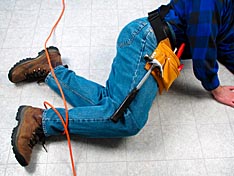
Construction sites are dangerous places. Contractors must comply with state workers' compensation laws and follow Occupational Safety and Health Administration (OSHA) requirements.
In many states, construction employees have the "exclusive remedy" of workers' compensation against their employer, but when a third party is responsible an employee may pursue a personal injury claim.
Injuries or fatalities caused by an employee of a different contractor
One common scenario is a worker for one subcontractor injured by a careless employee of another subcontractor—for example, a falling hand tool or masonry block.
Defendants in a personal injury lawsuit can include the individual who caused the accident, that worker's employer, the general contractor, and the project owner.
Because the individual who caused the accident often has limited assets, final liability frequently rests with the subcontractor or its insurer, especially where contracts include indemnity or hold‑harmless clauses and where subcontractors provide proof of liability insurance such as a general liability policy like those described in Construction Site Accidents and Liability Insurance.
Product liability lawsuits
Construction sites use heavy and potentially dangerous equipment. If a tool or machine has a safety defect—such as a handsaw whose automatic cutoff failed—an injured worker may sue the manufacturer, distributor, or installer instead of (or in addition to) pursuing a workers' compensation claim.
Workers' compensation may still apply, but product‑liability issues can complicate a claim and sometimes lead to WC denials, prompting a separate personal injury lawsuit against a party in the equipment's distribution chain.
State rules and industry-specific coverage
State workers' compensation rules vary. In some states, a third‑party cause affects WC eligibility; in others, an employee may receive WC benefits and still pursue a third‑party lawsuit.
Specialized situations—such as road construction or municipal projects—may require different workers' compensation programs or endorsements; for details on tailored policies see Street/Road Construction Workers' Compensation.
Practical steps after an on-site injury
Always complete an employee injury report immediately and notify your broker about the accident. Insurance brokers often communicate with carriers and can indicate whether a case will likely be handled under workers' compensation.
If a third party or defective equipment may be involved, document the scene, preserve evidence, and consider outside advice. It is also a good idea to talk to an agent about coverage options and next steps, and to consult legal counsel when appropriate.
Residential contractors in particular should verify their workers' compensation and related coverages; one place to review options is Residential Contractors Workers Compensation Insurance.
Frequently Asked Questions
Can a worker file a lawsuit against a third party after a jobsite injury?
Yes. If a third party (for example, another contractor or equipment maker) caused the injury, the worker may sue that party while still pursuing workers' compensation benefits in many jurisdictions.
Does workers' compensation prevent a third-party lawsuit?
Not always; workers' compensation is typically the exclusive remedy against the employer, but it does not necessarily bar claims against third parties who are at fault.
Who pays if defective equipment caused the injury?
Liability can fall on the manufacturer, distributor, installer, or a contractor depending on the defect and circumstances; insurance carriers and legal counsel often determine the responsible parties.
What should an employer do immediately after an on-site injury?
Complete an injury report, provide medical care, notify your broker or insurer, preserve evidence, and document the incident promptly.