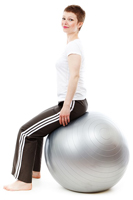
Exercise balls are popular with personal trainers and physical therapists because they strengthen your core muscles, improve your posture, relieve sore upper back muscles and increase flexibility. They come in several sizes, so choosing the right one helps you get the most benefit and stay safe.
Tips for choosing an exercise ball
-
Stand beside it
When you stand beside the exercise ball, it should come to your knees. Use the height chart below to find the correct diameter.
Height chart
- Under 5': 45 cm
- 5'1" to 5'8": 55 cm
- 5'9" to 6'2": 65 cm
- 6'3" to 6'7": 75 cm
- Over 6'8": 85 cm
In some cases you may want a larger or smaller ball. Choose a larger ball if you have long legs, are overweight, or have back problems. A smaller ball can be a better fit if you have shorter legs or are at the lower end of a height range.
-
Sit on it
Sit on the ball before you buy it to make sure it's the right size. If the ball is too small, your pelvis and hips can be unaligned and you won't get the full benefit. If the ball is too big you may feel unstable.
You know the ball fits when your feet are flat on the floor for even weight distribution, your knees are level with or slightly lower than your hips, and your ears, shoulders, and pelvis form a vertical line.
-
Stretch your arm
The length of your arm from shoulder to fingertip is another way to check size, especially if you'll use the ball for aerobic moves or to pick it up frequently.
Arm-length chart
- 22" to 25-1/2": 55 cm
- 26" to 31-1/2": 65 cm
- 31-3/4" to 35-1/2": 75 cm
-
Buy quality
Exercise balls vary in price. While cheaper options can be tempting, choose a ball made from durable, burst-resistant material that holds elasticity and air over time.
-
Keep it inflated
Balls lose air as they age and can be deflated slightly to adjust fit, but under-inflation reduces effectiveness. Maintain proper pressure so the ball provides the intended resistance, balance, and stabilization.
An exercise ball offers a variety of benefits and can be used in workouts or as an alternative seat for short periods. Choose the correct size, follow safety guidance, and consult a medical professional if you have health concerns before starting new exercises.
Frequently Asked Questions
How do I know if an exercise ball is the right firmness?
The ball should feel firm and spring back when you press it; if it compresses too much it is underinflated, and if it feels rigid it may be overinflated.
Can I use an exercise ball as my office chair?
Using a ball briefly can engage core muscles, but it is not recommended as a full-time replacement for an ergonomic chair because it may lack proper lumbar support for long periods.
How often should I check the ball's inflation?
Check inflation before each use and re-inflate as needed; also inspect the ball periodically for wear, punctures, or thinning material.
Are exercise balls safe for people with back pain?
Many people with mild back pain benefit from ball exercises that strengthen the core, but consult a doctor or physical therapist to ensure exercises are appropriate for your condition.