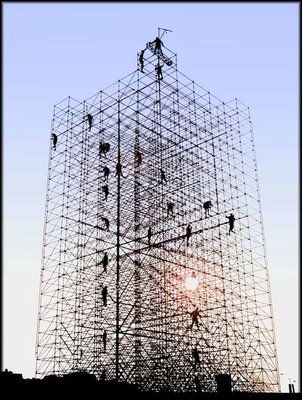
Construction workers, painting contractors, and window washers commonly use scaffolding and rigging on job sites. Although this equipment is intended to protect workers, it is also the source of many injuries and fatalities, including injuries to passersby.
Insurance such as workers' compensation and general liability can help protect companies, but it is good business and a moral obligation to take reasonable measures to reduce accidents and fatalities. For businesses that need industry-specific coverage, see Rigging and Scaffolding Insurance for options and guidance. For specialized service firms, consider Rigging and Scaffolding Service Insurance.
Rigging
Rigging describes the equipment and setups used to lift, hoist, push, or pull loads on construction sites. Licensed riggers install and inspect rigging so crane and hoist operators can move loads safely.
- Inspect the surroundings before lifting: ensure there is enough room to lift and move objects horizontally and watch for hazards like power lines and trees.
- Inspect equipment before use: OSHA regulations require that rigging and related equipment be inspected and that all controls function properly.
- Conduct frequent inspections while equipment remains in service.
- When a rigging setup is in use, barricade the area to keep the public and unrelated workers clear of the operation.
Contractors can also compare policy options at Rigging Contractors Insurance.
Scaffolding
Scaffolding accidents commonly involve planking or support failures, slipping, or falling objects. According to the Bureau of Labor Statistics, many injured workers report these causes after a scaffolding accident.
Following OSHA scaffolding regulations and safe work practices can substantially reduce these incidents. Key provisions and good practices include:
- Use fall protection or fall arrest systems when workers are 10 feet or more above a lower level.
- Maintain an uppermost guardrail height between 38 inches and 45 inches.
- Provide full planking or decking on scaffold platforms.
- For supported scaffolds, observe proper height-to-base ratios and use guying, ties, braces, or equivalent means to prevent tipping.
- Train every employee in correct scaffold use and safe work procedures.
Reducing accidents on sites requires regular inspections, proper training, and adherence to safety rules. More information is available at no charge from OSHA.
For businesses that focus specifically on scaffold exposures, see Scaffolding Risks Insurance to learn about coverages tailored to those risks. To review insurance options with an agent, you can ask an agent.
Frequently Asked Questions
What is the difference between rigging and scaffolding?
Rigging refers to equipment and methods for lifting and moving loads, while scaffolding provides platforms for workers to access elevated work areas.
Who is responsible for inspecting rigging and scaffolds?
Licensed riggers and competent persons are responsible for installing, inspecting, and maintaining rigging and scaffolding, and employers must ensure regular inspections.
When is fall protection required on scaffolds?
Fall protection is typically required when workers are 10 feet or more above a lower level, per OSHA guidance and common industry practice.
How often should scaffolding be inspected?
Scaffolding should be inspected before use, after any event that could affect its integrity, and periodically while in use according to site procedures.