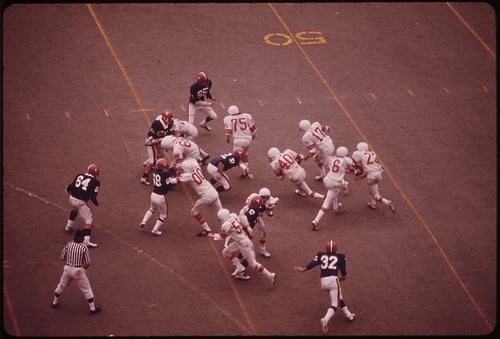
 Whether you watch the Super Bowl for the competitive drama or just for the commercials, Kevin Stipe asks you to consider these three similarities in strategy between championship caliber football teams and Best Practices insurance agencies.
Although the Super Bowl will be the most widely viewed sporting event of the year, not everybody appreciates the sport of football. George Will, a lover of baseball, notes that “Football combines two of the worst things in American life: It’s violence punctuated by committee meetings.”
Regardless of whether you find yourself watching the Super Bowl for the competitive drama or just for the commercials, you might consider these three similarities in strategy between championship caliber football teams and Best Practices insurance agencies.
1. Solid defense is necessary for success, but it can’t win championships by itself. Every year there are examples of teams that are great at keeping their opponent from scoring, but then lack the ability to score themselves.
Insurance agencies are no different. An agency’s defense is its customer service. Many agencies we encounter possess a world-class defense, with client retention rates in the mid-to-high 90s. These are agencies with well trained, technically astute professionals who rarely allow a competitor to take away a client. But in terms of offense — which, for an agency, means proactive new business development — they don’t know how to score. Sure, they can occasionally score on an interception or when an opponent slips up and fumbles on the goal line, but in terms of consistent new business production, they just aren’t built for it. They lack the personnel, and they lack a game plan.
2. Leveraging Impact Players is the key to a successful offense. Great offensive teams share two characteristics: (1) they have one or more impact players; and (2) they find a way to get the ball in the impact players’ hands early and often. During the past decade, salaries for top players have skyrocketed as teams have recognized that they can’t win a championship with average talent — particularly at the skill positions, such as running back, that are essential for scoring touchdowns. When a team steps up and spend tens of millions of dollars for a superstar running back, his coach won’t squander his talent by keeping him on the sidelines or asking him to play defense.
Producers are an insurance agency’s Impact Players. Every NFL coach knows the “gold standard” of performance for a great running back is to average 100 yards per game during the 16-game season. This year, as a group, the top 25% of the NFL’s starting running backs achieved this time-honored benchmark.
How are these impact players achieving such outstanding results? Aside from the obvious (they work hard!) they have the proper equipment, the support of capable professionals, and organizational resources that free them to spend time selling.
Interestingly, a Best Practices Study indicated that, despite already huge books of business, top producers consistently spend more than 1/3 rd of their time on new business development. It’s impossible to overstate the importance of this point: In any size agency, freeing your producers to spend more time selling will probably have more to do with your future success than any other single factor.
3. Championship teams have leadership that can inspire teamwork, even when enormous egos are involved. Two coaches who seem to be particularly effective in managing the egos of impact players are Jimmy Johnson and Bill Parcells. Each has won two Super Bowls, largely due to their ability to get the big-name players functioning as team members.
The Tampa Bay Buccaneers and their Super Bowl-winning head coach Jon Gruden showed that they understood this principle when they shocked the NFL in 2004 with the mid-season firing of star receiver Keyshawn Johnson, who had become a disruption to the team. This was a gutsy move, but one that will probably pay off as other players (both current and future) recognize the organization’s determination to build a true team.
Best Practices agencies don’t shy away from hiring superstars. But what makes them successful is their ability to get people working together as a team. An impact player producer is ultimately only as good as the support team they rely on, and the best ones recognize it. Over the years, we’ve encountered many agencies that have simply not had the determination or the guts to deal with their Keyshawn Johnsons. In the long run, these individuals take a toll on an agency far greater than the value they bring to it.
CONCLUSION
In light of these similarities, it’s not surprising that many Best Practices agencies are staffed with former athletes who thrive on competition. They hate to lose, and despise the notion that “just being in the game” is enough. They love competing against those who aren’t as committed to winning as they are. As age has caught up with them, they’ve been forced to trade in their cleats for a briefcase. But although their “playing field” has changed, the thrill of winning never gets old.